.

Puzzles To Remember

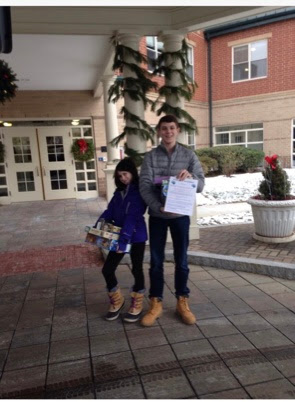
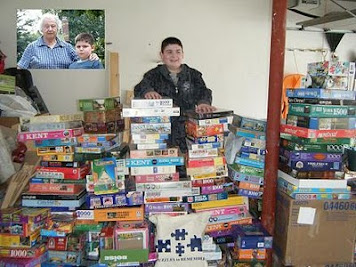
If you have puzzles that you would like to donate, please contact us at PuzzlesToRemember@gmail.com and we will find a location near you where you can bring your puzzles. We can also provide you with a donation letter so that you can claim the value of your puzzles as a tax deduction.

To see a 2-minute video of Max's projects, including Puzzles To Remember,
click here
.

Monday, February 6, 2012

An Unusual Request for Alzheimer's Puzzles

Share

By Max Wallack
Puzzles to Remember

Last week, I received an unusual request for Alzheimer’s puzzles.

I was contacted by a man named Robert. Robert used to live in New York City, but he currently lives in Quindio, Columbia, South America, where he teaches English as a Second Language.

Robert also works together with a group of local psychologists who do a lot of work with Alzheimer’s patients. Together, they are working on a program to integrate English as a Second Language as a therapy for Alzheimer’s patients.

Read More....

Saturday, February 4, 2012

Alzheimer’s Puzzles Sent to the Alzheimer’s Association’s Adult Day Centers in Ohio

Share

By Max Wallack
Puzzles to Remember

Last week, PuzzlesToRemember sent the Springbok PuzzlesToRemember to the NorthWest Ohio Alzheimer’s Association’s Adult Day Centers in Ohio. Below is the response from one of their Respite Coordinators:

Dear Max,

The puzzles arrived at both of our Adult Day Centers, and they are AWESOME! The large pieces and beautiful colors are perfect for our participants with Alzheimer’s disease. I know they will enjoy them immensely!

Traci


PuzzlesToRemember provides puzzles to facilities caring for Alzheimer’s patients. Any caregiver who would like to purchase these puzzles for someone with Alzheimer’s can view them here.


Max Wallack is a student at Boston University Academy. His great grandmother, Gertrude, suffered from Alzheimer's disease. Max is the founder of PUZZLES TO REMEMBER. PTR is a project that provides puzzles to nursing homes and veterans institutions that care for Alzheimer's and dementia patients.

Read More....

Tuesday, January 31, 2012

A Note of Thanks from Rock Spring, Wyoming

Share

By Max Wallack
Puzzles to Remember

Today, I received the following note of thanks from Cindy, at the Sage View Care Center in Rock Spring, Wyoming for having donated Springbok PuzzlesToRemember to that facility.

“Thank you so much for the puzzles you recently donated to our facility. I was recently appointed the coordinator over our Alzheimer’s unit, and have been desperately looking for some good puzzles for our wonderful residents to use. Your donation arrived just when I needed them the most. Thank you for taking the time and energy to include us in your efforts. There just are not words to express how appreciative I am for you and the work you do.”

I think Cindy will make a great Activity Director and Program Coordinator!


Max Wallack is a student at Boston University Academy. His great grandmother, Gertrude, suffered from Alzheimer's disease. Max is the founder of PUZZLES TO REMEMBER. PTR is a project that provides puzzles to nursing homes and veterans institutions that care for Alzheimer's and dementia patients.

Read More....

Thursday, January 26, 2012

Prejudice and Alzheimer's Disease

Share

By Max Wallack
Puzzles to Remember

This past week we celebrated Martin Luther King Day. I made of point of delivering puzzles to three nursing facilities in honor of what this day has come to symbolize. I have also applied for a college scholarship, the Martin Luther King Scholarship, which is a scholarship that Boston University grants to students who get good grades, but also serve society, while respecting individual differences.

Dr. Martin Luther King said, “We may have all come on different ships, but we are in the same boat now.”

You may be wondering, by now, what any of this has to do with Alzheimer’s and/or dementia. Well, since I have been thinking about these matters all week, I have a story about Great Grams that I would like to share.

In July of 2006, we took a family trip to Hawaii, including Great Grams. I have written about many aspects of this trip previously, but I don’t think I have ever shared the events at the airport in Honolulu as we waited for our return flight home.

(As a reminder, Great Grams was about 94 at the time, and she had moderate to advanced Alzheimer’s disease.)

My family had arrived early for the flight. We were all quite tired, since many of the events in Honolulu had involved significant episodes with Great Grams.

Suddenly, Great Grams looked up and noticed several Black individuals sitting in the same boarding area. She became very upset and clearly announced that she would not be getting on the flight that had Black people on it.

My family, including myself, was entirely taken by surprise. In fact, we were shocked beyond belief. Great Grams had lived her whole life in integrated neighborhoods. She raised her family in a Boston Housing Authority apartment. Various races were certainly nothing new to her, and we had NEVER heard her express any prejudice previously.

We weren’t sure how to handle this situation. Great Grams would always perseverate; she continued to be adamant that she was not getting on that plane. We knew reasoning would not work.

After trying various solutions, we tried something that worked. We got up and changed our seats so that we were not facing the African American individuals. Sure enough, within a few minutes, Great Grams forgot all about them.

Then, something happened that made the whole incident more vivid in my memory. Some of the young African American children from this family were running around the boarding area, playing happily. Now, many of you may remember that Great Grams loved children.

Great Grams called the children over to her and began playing with them. She commented on how cute and smart they were. She was so happy! She enjoyed playing with those children for most of an hour.

Now, I think back about how much Great Grams’s dementia taught me about prejudice. She clearly demonstrated to me that prejudice is fear in its very basic state. Great Grams had never previously exhibited prejudice, but she was a very, very fearful individual.

She was fearful of these individuals that appeared different from herself. Yet, she was very loving to the children, whom she didn’t fear.

Great Grams clearly taught me an important life lesson that day when I was ten. I learned that prejudice is a function of fear. I also learned that most of the agitation evidenced by Alzheimer’s patients is rooted in fear and misunderstanding.

Is this true today for the many people in our society that shun Alzheimer’s and dementia patients? Is this a case of prejudice based in fear? Are some siblings and children of Alzheimer’s patients fearful of what they don’t understand? Is it because Alzheimer’s patients appear different sometimes? Do people turn away because they afraid that they may be looking at their own future? Are they afraid they won’t be capable of doing the job of the full-time caregiver, so they just don’t try at all?

Can we look deeper and see the person that is “still there?” Can we find that happy child that is still within them? If we can overcome our fears, we will find that there remains something in there that can still be of value not only to them but to ourselves.

We all need to do this because, with the impending tsunami of Alzheimer’s disease, in the words of Dr. Martin Luther King , we will soon all be “in the same boat.”


Max Wallack is a student at Boston University Academy. His great grandmother, Gertrude, suffered from Alzheimer's disease. Max is the founder of PUZZLES TO REMEMBER. PTR is a project that provides puzzles to nursing homes and veterans institutions that care for Alzheimer's and dementia patients.

Read More....
PUZZLES TO REMEMBER was founded in 2008 by Max Wallack, in memory of his great-grandmother, Gertrude Finkelstein, who died of Alzheimer's disease in 2007.
Puzzles To Remember is registered in Massachusetts as a public charity. Contributions are welcome, and are tax deductible under sec. 501(c.)3 of the Internal Revenue Code.

For more information, write to us at PuzzlesToRemember@gmail.com